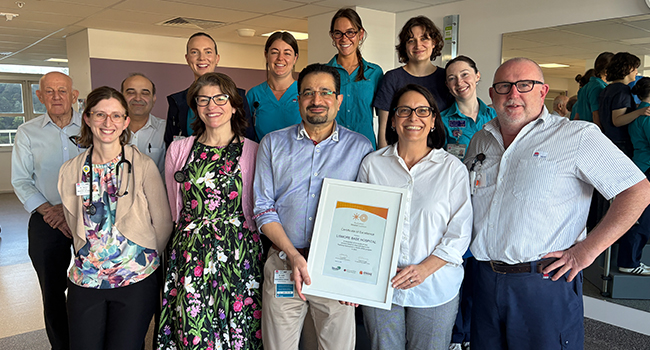
The stroke team at Lismore Base Hospital (LBH) has been recognised with a prestigious World Stroke Organization (WSO) Angels Gold Status Award, marking the 7th time the hospital has achieved this remarkable level of excellence in stroke treatment and care.
The Angels Initiative, a partnership between the World Stroke Organization, European Stroke Organisation, and Boehringer Ingelheim, aims to optimise the standard of treatment in stroke centres worldwide and improve patient outcomes by setting global benchmarks for best practice stroke care.
Lismore Base Hospital Stroke Coordinator Kim Hoffman said achieving WSO Gold Status was a great honour and testament to team effort to enhance stroke care.
“Stroke is a time-critical medical emergency where blood supply to the brain is interrupted or reduced,” Kim said.
“With each minute that goes by, more brain cells can be lost, and the risk of disability and death increases.
“Acting swiftly on the signs of stroke and implementing best practice care requires coordination between ambulance, emergency department, radiology, and stroke unit staff.”
LBH treats approximately 300 strokes each year. Training, protocols, and the performance of the hospital’s stroke unit were assessed as part of the WSO Angels Awards. For WSO Gold Status, this includes a target of restoring blood-flow to the brain to more than 50 per cent of eligible patients within 60 minutes of their hospital arrival.
“Ensuring appropriate patients receive clot-busting therapy within 60 minutes of arriving at the hospital door is the gold standard and means that more people will survive and live well after stroke,” Kim said.
The Angels Initiative Lead in Australia, Kim Malkin, said every step toward improving care and outcomes for stroke patients was worth celebrating, as there were approximately 45,785 stroke events across Australia each year – around 125 every day.
“Every hospital that achieves WSO Angels Gold Status should be justifiably proud, as should the communities they serve,” she said.
Time is Brain Awards
Excellence in stroke treatment has been further demonstrated across Northern NSW LHD in 2025, with Tweed Valley and Grafton Base hospitals acknowledged alongside Lismore with several Time is Brain awards.
Tweed has received eight Time is Brain awards so far this year, Lismore seven, while Grafton has received one.
The Time is Brain awards are presented by the NSW Telestroke Service, which provides 24/7 access to specialist stroke physicians via video consultation. This allows specialist stroke diagnosis and treatment to occur from the moment patients arrive at hospital.
Tweed Byron Murwillumbah Network Acting Stroke Care Coordinator Georgia Marr said she was exceptionally proud of her team’s achievements.
“With strokes, time is of the essence,” Georgia said.
“When a code stroke is called in ED, it is in the national recommendation to provide thrombolysis, or clot-busting medication, when the patient is eligible within an hour of arriving to hospital.
“The fastest time achieved at Tweed Valley Hospital is 17 minutes.
“This year has seen multiple patients present with stroke, receive the clot-busting medications, and completely regain function with no ongoing deficits allowing them to return directly home.
“Once patients are admitted with a stroke, we work as a multidisciplinary team, with doctors, nurses, radiographers, physiotherapists, occupational therapists, speech pathologists, social workers, dieticians and pharmacists all working together.”

LBH stroke coordinator Kim Hoffman showing off the Team's award.
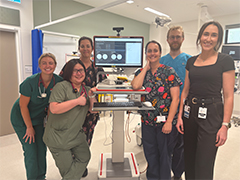
The award-winning Tweed Valley Hospital ED Stroke Team, from left: Dr Tia McLaren, Dr Kathryn Llanos Dee, Rachel Edwards, Anna Hamilton, Aaron Doherty, Georgia Marr.
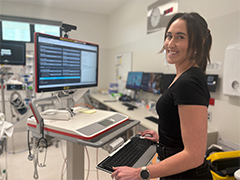
Tweed Byron Murwillumbah Network Acting Stroke Care Coordinator Georgia Marr.
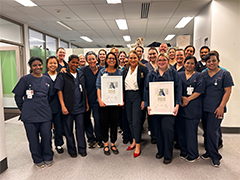
The LBH Stroke and Emergency Department team celebrating their award.
Pictured top:
Some members of the LBH Stroke and Emergency Department team celebrating their award.